Sunday, November 17, 2013

Iran Calls on India, China to Join IP Gas Pipeline Project

Iran has called on both India and China to join the under-construction pipeline projected to carry natural gas from Iran to Pakistan, Ali Majedi, who is deputy minister for international and commercial affairs, said on Saturday.
Iran expects India to overcome its doubts and join the pipeline, previously known as the Iran-Pakistan-India Pipeline.
“If India joins the pipeline, the interests of all three countries – Pakistan, India and Iran – will be guaranteed,” he said.
“Given the initial design of the Peace Pipeline, even China can join this pipeline,” he said.
Majedi said that Iran has met its obligations regarding gas exports to Pakistan, adding that, “Iran has heavily invested in this pipeline project and has constructed its own section of the pipeline.”
“Pakistan is required to construct pipeline to take delivery of gas from Iran, but it has taken to serious action to that effect.” 
The pipeline starts from Asalouyeh in southern Iran and stretches 1,172 kilometers through Iran. The Iranian section is known as Iran's Seventh Cross-Country Gas Pipeline has already been constructed. The first 902-kilometer part of this section runs from Asalouyeh to Iranshahr. The second 270-kilometer part runs from Iranshahr to the Iran–Pakistan border.
In Pakistan, the length of the pipeline is 785 kilometers. It will pass through Baluchistan and Sindh. In Khuzdar, a branch would spur off to Karachi, while the main pipeline will continue towards Multan. From Multan, the pipeline may be expanded to Delhi. The route in Pakistan may be changed if China will participate in the project.
The initial capacity of the pipeline was to be 22 billion cubic meters of natural gas per year, which was expected to be raised later to 55 billion cubic meters. However, as a bilateral project between Iran and Pakistan, the pipeline will carry only 8.7 billion cubic meters of gas per year as contracted and 40 billion cubic meters as a maximum capacity. 

Thursday, November 14, 2013

ECC approves ADB as adviser for TAPI gas pipeline project

ISLAMABAD: The Economic Coordination Committee (ECC) on Wednesday took the first major step towards an alternative gas pipeline which involves India and Afghanistan as well and appointed the Asian Development Bank (ADB) as the transaction adviser, a key technical requirement.

Finance Minister Senator Ishaq Dar said, “Involving a credible financial institution as transaction adviser will ensure greater transparency in the deal.”The Turkmenistan-Afghanistan-Pakistan-India (TAPI) pipeline is supported by the US as against the Pak-Iran pipeline, which is facing serious problems because of lack of finances. Iran has backed out of its commitment to provide $500 million to Pakistan.

The meeting was informed that foreign remittances had reached $5.2 billion in the first quarter of the FY 2013-14, 6.3 percent more than the corresponding period last year and the foreign direct investment had increased by 85 percent in the first quarter of this financial year.“This speaks volumes about the seriousness of the PML-N government in the economic uplift of the country,” the finance minister said.

Ishaq Dar, expressing concern over inflation and price hike in the country, said that it was mainly due to an increase in international fuel prices and expressed the hope that there would be little adjustments in the future. “The government is sensitive to the hardships of the people and is on an average providing a subsidy of around Rs2.2 billion every month just to lessen the burden of the rise in fuel prices on the common man.”

The meeting noted that the recommendations made by a committee constituted by the ECC under the chairmanship of the State Bank of Pakistan (SBP) governor would study the process of portfolio investment.

The meeting also discussed a draft policy for regulation of organisations receiving foreign contributions.It is pertinent to mention here that the ECC, in its meeting held on July 2013, constituted a committee under the chairmanship of the minister for science and technology to review the regulatory framework for NGOs/INGOs working in Pakistan.

The ECC was told that a draft policy had been prepared after meeting with all the stakeholders and the matter would now be brought up before the ECC after further consultation with the Law Division in the next two weeks.

The ECC approved the transfer of Engro Corporation Ltd’s investment in Engro Foods, Netherland B.V. to Engro Foods (Ltd) Pakistan.Regarding the Energy Efficiency Audit of the captive power plants, the ECC decided to form a committee under the chairmanship of secretary, Ministry of Water and Power and comprising representatives of ministries of Industries and Production and Petroleum and Natural Resources, Commerce, Nepra and Ogra. The committee will propose a viable plan for the capacity building for energy efficiency audits and to introduce transparency in the system. “We shall start the process of conducting energy efficiency assessment from the public sector and will initiate an awareness campaign for the private sector to use methods that could save energy and help bring the country out of its present energy crisis,” Ishaq Dar said.

He expressed satisfaction over the positive development that large scale manufacturing had increased by 12.8 percent during the month of September.This sector has experienced a growth of 8.4% during the first quarter of the financial year 2013-14, mainly because of the proactive approach of the government in liquidating the circular debt resulting in increased generation. Consequently, growth in the large-scale industrial sector experienced an increase of 6 percent in June 2013, which gradually increased to 12.8% in September because of the addition of 1,700MW to the national grid.

The ECC did not come up with the decision to impose a ban on export of tomatoes and onions as was suggested by the Ministry of Food and Security. It also failed to come with an alternative plan to provide relief to the inflation-stricken masses.

Sources said that the Finance Ministry was evasive to place a ban on the export of onions and tomatoes as per the undertaking that had been extended to the International Monetary Fund (IMF) that the government will not take any policy decision to arrest the inflation at least for one year.

However, Ishaq Dar rejected the proposal of banning the export and advised the officials of the Ministry of Food Security to bring a better and much more practical proposal to check the rising prices on long-term basis. The ECC also directed the Ministry of Food Security to form a committee to keep a watch over the prices and deferred the matter till the next meeting.

It is interesting to note that the officials of the Food Security Ministry came up with strange arguments during the meeting saying that during the past three days a survey was conducted in the local markets and it was observed that the prices were already going down and by the end of this month, they would improve further.


Pakistan tells US Iran pipeline contractual obligation: minister

Islamabad, Nov 13, IRNA – Pakistan has told the United States that it is under “contractual obligations” to complete the Iran gas pipeline project.

Pakistan’s Minister for Water and Power Khawaja Muhammad Asif made the remarks during his visit to Washington for talks on energy cooperation between the two country. 


The Minister told Dawn newspaper in Washington that improved relations between the United States and Iran would also ease American pressures on the pipeline. 


“Building the Iran-Pakistan gas pipeline is our contractual liability,” said Khawaja Asif while explaining his government’s position on the project. “If we do not, we will have to pay the penalty for breaching the contract,” he was quoted in reported remarks om Wednesday. 


Without naming the US administration, the minister said that those who wanted Pakistan not to build the project “should be ready to pay the fines”. 


Pakistan insists that the pipeline project does not breach this law as Iran, and not foreign investors, were building the pipeline. 


Last week, the US and Iran came close to reducing their differences which, Mr Asif said, was a good sign for the pipeline project. 


Officials who attended the meeting said delegates also considered a proposal for the integration of energy infrastructure in South Asia, which can bring gas and oil from energy-rich to energy-starved nations. 


Carlos Pascual, the US Special Envoy and Coordinator for International Energy Affairs, the two visiting ministers from Pakistan and the US ambassador in Islamabad, Richard Olson, co-chaired Tuesday’s meeting. 


Minister for Petroleum and Natural Resources Shahid Khaqan Abbasi, who is also in Washington, said Pakistan was seeking new technology and investments from the United States to meet its ever increasing energy demands.

Your argument is invalid’- Analysis

Pakistan’s future energy endeavors were discussed in the Pakistan-US energy group meeting on Tuesday, and our longtime allies unsurprisingly seem to have a barrage of issues with the plans Pakistan wants executed to cover the shortfall. However, this time around, their counter arguments can be paraphrased in plain language as simple as, ‘You cannot do it, because we said so’. With regards to the Iran-Pak pipeline, the US stance is that that if Pakistan chooses to go ahead with the construction, it may find itself subject to sanctions, as a result of a US law which forbids supporting any foreign investment in Iran. However, they fail to realize that Pakistan is investing on the pipeline only on its own side of the border, and therefore should be safe from sanctions. Also, so far the US has chosen to ignore the fact that if Pakistan fails to meet its end of the bargain in the stipulated timeframe, it will be forced to pay the penalty of a whopping three million dollars. Not yearly, not monthly, but daily. So for the US to obstruct this deal is illogical and detrimental to Pakistan’s economy.
Their opposition to power generation by coal also came as a surprise considering Pakistan has an excess of carbon credits and abundant untapped coal reserves. Considering that this country is still in its developing stages, it should be allowed to burn coal as a form of fuel given that all developed nations have had that opportunity and have contributed significantly to carbon emissions across the globe. It is unfortunate that time and again Pakistan finds itself seeking a stamp of approval from a foreign country in order to protect its national interest. It is handicapped without foreign aid, and the US, for a change, must look at things from the Pakistani perspective.
The idea of a global policeman is fraught with controversy, but traditionally, the least that is expected is that it is supposed to be fair and logical. The US’ recent behavior is not reflective of that, but by making these demands from Pakistan it goes a step further down the slippery slope and hence, must reconsider. Pakistan is mired in problems and lacks initiative to find solutions, yet the precious few that are generated are shot down for no reason. Given that the US is supposed to be one of the key allies of this country, it should assist Pakistan in the rare positive steps that it takes for itself, instead of being an obstacle in their path.

Iran has backed out of gas pipeline project: Dar

ISLAMABAD: Federal Finance Minister Senator Ishaq Dar has claimed that the Government of Pakistan will not abandon the Pak-Iran gas pipeline project under the US pressure but it was actually Iran which had backed out of financing the project, despite an earlier promise.

Speaking in Capital Talk on Geo News with Hamid Mir on Wednesday night, Ishaq Dar said that he had recently met the Iranian finance minister on the sidelines of the World Bank and IMF meetings in the US. He told his Iranian counterpart that Iran had promised to provide $500 million for the Pak-Iran gas pipeline project.

The Iranian finance minister responded in clear words that his government was suffering from economic crisis and they were not in a position to finance the project.Dar said he even requested the US officials not to oppose the Pak-Iran gas pipeline project because now the US was trying to improve its relations with Iran.

He said Pakistan was still committed to the project but now the Iranians had backed out. He said he could not carry forward this project single-handedly due to the shortage of finances.Responding to another question, he said that the Ministry of Finance was ready to provide all funds to the ECP for the coming local bodies elections.

He said that his ministry informed the ECP in writing a few days back that it would give Rs6 billion to the ECP for the election.Dar also said that a proposal was given to him on Wednesday afternoon to ban the export of tomatoes to control the prices but he refused to do so just because it would help the Punjab only.


He said that these days the Punjab was facing a shortage of tomatoes and that was why the prices were going up but the tomato crop of Sindh, the KP and Balochistan was ready now.“We do not want to minimise the profit of growers from three provinces just for the benefit of the Punjab,” he said.

Monday, November 11, 2013

The Iran-Pakistan pipeline: Finding the win-win for Pakistan

The government’s strategy on the IP pipeline has been dominated by the issue offinancing the Pakistani legof the pipeline, public pressure stemming out of acute power shortages and a political consensus that demands standing up to the threat of US sanctions. However, an overemphasis on these three factors should not hamper our ability to analyse other important dynamics involved in this project.
Indeed, the price at which Pakistan would contractually purchase Iranian gas is linked to international crude oil prices. Iran itself imports gas from Turkmenistan at USD 4/MMBtu while the price at which it would export to Pakistan is an exorbitant figure of USD 14/MMBtu. According to a recent report by Sustainable Development Policy Institute (SDPI), this would bring about a “death sentence” for Pakistan’s economy. Thus, if the pipeline project was to continue, Pakistan might end up having surplus supply of gas that consumers and local industry cannot even afford.
Moreover, Turkey, a current importer of Iranian gas still faces trouble getting adequate supply of gas from Iran during winter months, a time when Iran’s own domestic demand for gas peaks. On October 1, Iranian Oil Minister Bijan Namdar Zanganehhimself raised concern about Iran facing serious gas shortage because of slow progress in raising levels of production from South Pars – the field that is supposed to fill the IP pipeline. If such factors were seriously taken into account, the pipeline agreement would likely have never been signed at the first place.
In addition to exploring other options from Pakistan’s indigenous resources and renewable energy sector, the question that policymakers should now be asking is how the IP pipeline project can best come to an end so that Pakistan’s international standing is not damaged. It is thus important to explore the various exit strategies Pakistan could adopt and what implications each of them entails.
First, as Pakistan seems to do with other problems, politicians might be comfortable blaming the potential pullout on US pressure. However, this will not only prove unfavorable for the goal of reviving Pakistani-US ties, but will also seriously hamper the approval ratings of the new Pakistani government.
The second way out is to blame the previous government. While this option might be easy to digest, it has serious long-term repercussions. Holding the previous administration accountable for the failure creates a precedent in which a new Pakistani government can arbitrarily scrap an international agreement. This in turn creates a lack of trust among potential regional and international partners in Pakistan’s ability to see its agreements through from one administration to another.
The third possibility is to keep the project lingering. This will attract more energy aid projects from the United States and cheaper oil offers from Saudi Arabia. However, given that Pakistan will be liable to pay a $3 million per day penalty to Iran if its side of the pipeline is not completed by the end of 2014; this option is also not plausible.
The fourth possibility is to renegotiate the gas prices and the terms of the agreement with Iran. Though this option might be successful in de-linking gas prices from those of international crude oil, it would neither solve the financing issue nor the security concerns in regard to Balochistan.
These flawed options make the situation seem discouraging, in this conundrum lies a tremendous diplomatic opportunity which if articulated well could provide Pakistan with a win-win outcome.
Instead of provoking Iran’s anger by scrapping the gas pipeline deal without offering anything against it, Pakistan should replace it with another contract to import more Iranian-produced electricity. Pakistan is already importing Iranian electricity at Rs.10/unit and could enhance its import to the efficient levels of the current transmission capacity. Even increasing this capacity by building more transmission lines is a cheaper and a more viable option than to proceed with the IP pipeline project. Furthermore, it will also be in Iran’s interests to establish more power plants within the country which could be used for both, its domestic production and as well as for importing gas to Pakistan.
Meanwhile, pulling out of the project will also give Pakistan greater leverage with the United States and Saudi Arabia – the two staunchest opponents of the pipeline. Pakistan could use this leverage to procure favorable oil prices from Saudi Arabia, as well as assurances of heavy investment from the United States and other international partners to exploit shale gas and renewable energy such as solar, biomass, and tidal energy – sectors that are estimated to have tremendous potential. This will also improve Pakistan’s energy diversity and, in so doing, strengthen its energy security in the long run.
This exit strategy will allow the Pakistani government to save face without having to compromise its relations with either Iran or the United States. Additionally, it will increase the government’s ability to proceed with other necessary yet unpopular steps to put the economy on track. Even Iran will experience no short-term loss as a result of this plan; the 900 km pipeline it has completed on its side of the border is still necessary for its own domestic supply of gas.
The author is a Research Associate at the Middle East Institute in Washington D.C. and can be contacted at akhurram@gmu.edu. Assertions and opinions in this blog are solely those of the author and do not necessarily reflect the views of the Middle East Institute

Iran exports over $5b worth of electricity and electrical equipment annually: official

TEHRAN – Iran annually exports over $2 billion worth of electricity and $3.1 billion worth of electrical equipment, the Iranian deputy energy minister said on Sunday.
 
IRNA quoted Sattar Mahmoudi as saying that the national power generation capacity should be increased by 5 gigawatts per year. The goal requires 100 trillion rials (about $4 billion based on the U.S. official exchange rate of 24,900 rials) investment, he added. 
 
On October 30, Iranian Energy Minister Hamid Chitchian said that exporting technical and engineering services in the field of water and electricity to other countries, especially in the Middle East, is one of the policies of the Ministry of Energy.
 
Iran has already launched 59 projects in Azerbaijan, Ethiopia, Armenia, Uzbekistan, South Africa, Afghanistan, Algeria, United Arab Emirates, Bangladesh, Pakistan, Tajikistan, Turkmenistan, Sri Lanka, Syria, Iraq, Oman, Kenya, Lebanon, and Nigeria. 
 
These projects are valued at $3.2 billion, of which 13 projects, worth $1.4 billion, have been terminated.
 
On October 9, Homayoun Haeri, the managing director of the Iran Power Generation, Transmission and Distribution Management Company (TAVANIR) said that Iran’s total power generation capacity currently stands at 68.38 gigawatts.
 
Iran exports electricity to Turkey, Armenia, Turkmenistan, Azerbaijan (including the Nakhchivan Autonomous Republic), Pakistan, Afghanistan, Syria, and Iraq.
 
Iran seeks to become a major regional exporter of electricity and has attracted more than $1.1 billion in investments for the construction of three new power plants.
 

Our energy options- An Opinion

Buried in the 2,500 words of the Pakistan-US joint statement issued after Prime Minister Nawaz Sharif’s visit to the US last month is a sentence saying that the US president “welcomed steps taken by Pakistan and India to improve their economic relations, including by exploring electricity and gas supply agreements, developing a reciprocal visa regime, and expanding bilateral trade”. 

Obama’s support for “electricity and gas supply agreements” between Pakistan and India is a reference to an Indian offer to supply electricity and gas to Pakistan, which the Nawaz government would like to accept if it can sell the deal to a sceptical Pakistani public. 

India has been pressing Pakistan with great persistence to accept that offer despite the fact that Delhi has suspended the regular bilateral dialogue between the two countries. India’s keenness to supply electricity and gas to Pakistan is all the more remarkable because India itself faces a domestic power shortage and the gas that it would like to export to Pakistan has not been produced indigenously but imported from another country. 

Clearly, the Indian offer and US support for it are part of a joint Indo-US strategy for the region. Delhi, as is well-known, has long been urging that Pakistan and India should concentrate on building economic and cultural ties, while putting Kashmir and other political issues on the backburner. This is a line that Washington has also embraced enthusiastically, especially as it prepares to withdraw the bulk of its forces from Afghanistan next year. 

The reason, quite simply, is that in the post-2014 scenario, the US would like India to play a larger political and economic role in Afghanistan and Central Asia, exactly as Delhi has long yearned for. 

A major obstacle to the realisation of those plans is that Pakistan, for very good reasons, has refused to allow the use of its overland transit routes to India – so far, at least. But with Nawaz in power, Delhi and Washington now see that there is a good chance that Pakistan could modify its longstanding position on the issue. 

Nawaz himself has repeatedly spoken of his wish for the opening of transit routes between South Asia and Central Asia but he has had a difficult job selling to the Pakistani public the idea of giving India access to Afghanistan through Pakistani territory, given Delhi’s record of trying to export subversion and instability to Pakistan from Afghan soil. 

The calculation in Delhi and Washington now is that if India provides some much-needed electricity and gas to Pakistan, Nawaz might have an easier time overcoming domestic opposition to the opening of the country’s transit routes to India.

Reservations on the import of electricity from India were expressed forcefully at a meeting of the Senate’s Standing Committee on Water and Power last September. Members of the committee pointed out that India would be in a position to discontinue electricity supply at any time and could use that option to harm Pakistan’s economy, or to exert political pressure on the country. The committee, therefore, urged the government to turn down the Indian offer of electricity. 

The same considerations that militate against the purchase of electricity also apply to gas supplies from India. This should not surprise India because when it quit the Iran-Pakistan-India (IPI) gas pipeline project in 2009, one of the reasons it cited was that Pakistan could cut off supplies in a crisis.

Some circles in Pakistan have also pointed to the danger that an agreement to buy electricity from India could make it difficult for Pakistan to raise objections to the proposed construction of several hydro-electric power stations by India on the three western rivers which have been allotted to Pakistan under the Indus Waters Treaty. This argument cannot be dismissed lightly, because even if Pakistan’s legal rights under the treaty will not be affected, India could still claim a measure of political legitimacy for its breach of the treaty if Pakistan were to enter into an electricity purchase agreement.

Despite all these weighty grounds against the purchase of electricity and gas from India, the Nawaz government is going full steam ahead. Although Nawaz approved the purchase of 500MW of electricity from India last September through a transmission line from Amritsar to Lahore, the government has withheld this information from the public. 

The story on gas purchases is similar. Talks are underway for the supply of five million standard cubic meters per day of gas by GAIL, India’s state-owned gas company, through a newly-laid 110-km pipeline from Jalandhar in India to the Pakistan-India border near Wagah. The gas to be exported to Pakistan would be purchased by India from Qatar in the form of liquefied natural gas (LNG).

The main beneficiaries of the proposed electricity and gas purchases from India will be Nawaz’s political constituency in and around Lahore, while the long-term interests of the country will suffer. But he seems more interested in boosting his own popularity in his political stronghold in Punjab. 

As Shahid Khaqan Abbasi, minister for petroleum and natural resources, told a seminar last Monday, there are other more attractive options available to overcome the energy crisis: LNG imports and two gas pipeline projects, namely Iran-Pakistan (IP) and Turkmenistan-Afghanistan-Pakistan-India (Tapi). 

The IP project has been stymied by US opposition, financing problems on the Pakistan side and the uncertain law-and-order situation in Balochistan. None of these difficulties is insuperable if the government were to get really serious about it, but it will take time. The main problem is that the Nawaz government does not want to be at odds with Washington over this issue. 

About two weeks ago, Iranian Oil Minister Bijan Zanganeh said there was “no hope” of exporting gas to Pakistan because the financing was not there. That does not mean that Iran regards the project as dead, much though a few countries would like that to happen. Iran remains interested and the project could still go ahead if the necessary funding is arranged.

The rival project that the US and India are promoting for strategic reasons of their own is Tapi. It was initially proposed in 1991 for shipping gas from Turkmenistan via Afghanistan to Pakistan. India joined the project in 2008 and sees it as a way of expanding its economic presence in Central Asia. 

The importance that Washington attaches to Tapi is evident from the fact that Obama himself sent a letter last month to the President of Turkmenistan to convey his support and express his desire that a US firm should construct it. The US expectation is that Tapi would give a much-needed boost to its ‘New Silk Road’ project for the region. Pakistan also has a strong interest in Tapi because it will help stabilise the Pak-Afghan border, besides helping Pakistan overcome its energy shortage. 

Since the IP and TAPI projects will take time, Pakistan needs to push ahead with LNG imports as the short-term option. Negotiations with Qatar for the purchase of LNG, which were started some time ago, should be brought to an early conclusion and the construction of an LNG terminal at the Karachi port should not be delayed. According to Abbasi, the country is incurring an annual loss of $2 billion because of the delay in the import of LNG. But he has blamed the courts and the media for it. This is an unacceptable excuse. 

The direct import of LNG from Qatar would be a far better option than the purchase of electricity or Qatari gas from India. But the Nawaz government has other plans. Tariq Fatemi, the prime minister’s special assistant on foreign policy, said last week, “We believe there can be no peace and development in Pakistan unless it has a cooperative relationship with India.” 

This is completely wrong. Pakistan’s future depends entirely on its own people and leaders and on the policies of the government, not on the cooperation of any other country, much less that of our eastern neighbour. 

The writer is a former member of the Pakistan Foreign Service.

Email: asifezdi@yahoo.com 

Sunday, November 10, 2013

Multibillion-dollar project: Progress on Iran pipeline project hinges on US talks

Progress on Iran pipeline project hinges on US talks. PHOTO: AFP
ISLAMABAD: 
Pakistan will press the United States to exempt the multibillion-dollar Iran-Pakistan (IP) pipeline project from sanctions during the revised strategic bilateral dialogue, which kicks off in Washington on November 12.
The $7.5-billion project has faced repeated delays since it was conceived in the 1990s to connect Iran’s giant South Pars gas field to consumers in Pakistan and India.
The Washington dialogue – which is a followup to Prime Minister Nawaz Sharif’s recent visit to the US – will focus on revising relations between the two countries, especially with regards to Pakistan’s energy needs.
The Pakistani delegation will be jointly led by Petroleum Minister Shahid Khaqan Abbasi and Power Minister Khwaja Asif.
Officials privy to the development told The Express Tribune that the delegation will raise the issue of possible US sanctions against the IP project because it is essential for meeting the country’s growing energy demands.
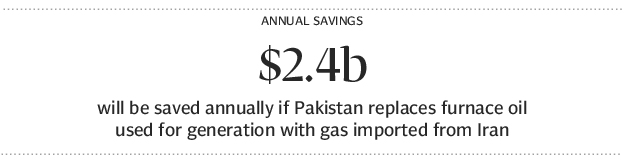
According to an analysis prepared by the petroleum ministry, replacing furnace oil used for power generation with gas imported from Iran will result in annual savings of $2.4 billion.
The officials said that progress on the IP project will depend on the outcome of the revised dialogue which would be the final round of deliberations on the issue.
The United States has steadfastly opposed Pakistani and Indian involvement in the project, saying it could violate sanctions imposed on Iran over nuclear activities Washington suspects are aimed at developing an atom bomb – a charge denied by Tehran.
Instead the US has been urging Pakistan to go for the Turkmenistan-Afghanistan-Pakistan-India (TAPI) project. US and European Union sanctions against Iran have also stalled progress on the IP pipeline since the country has not been able to import the technology needed to develop the South Pars gas field, the officials told The Express Tribune.
Meanwhile, the officials said that the Pakistani delegation will also discuss the possibility of striking a civil nuclear deal similar to the one the US has with India.
On the other hand, the US is expected to offer Liquefied Natural Gas (LNG) at cheaper rate in an attempt to discourage Pakistan from pursuing the IP project, according to sources.  Over the next few years, the US will emerge as a potential exporter of LNG after the discovery of shale gas reserves which have led to a decline in prices.
Published in The Express Tribune, November 10th, 201

Iran ready to renegotiate gas price with Pakistan

TEHRAN: Iran has said that it is ready to renegotiate the price of its gas supplies to Pakistan.

“The price for gas to Pakistan is not fixed, hence we can talk with them (Pakistani officials) about the price of the gas supplies to that country,” Managing-Director of the National Iranian Gas Company (NIGC) Hamid Reza Araqi said, reports Fars News Agency.

Araqi added that as per the contract the two sides can negotiate the price of the gas supplies for export to Pakistan after several years and reach a sum up.


Last week, Iranian oil ministry announced that the country is likely to give up on the multi-billion-dollar Iran-Pakistan gas pipeline project. However, Pakistani Foreign Ministry Spokesman Aizaz Chaudhry reiterated that Islamabad is resolved to pursue expedition of the pipeline project.