Thursday, October 31, 2013

At stake: LNG services tender faces an uncertain fate

Inter State Gas Systems is now facing a tricky situation as it needs to find a way out to avoid controversy which could mar the whole process. PHOTO: FILE
ISLAMABAD: 
A tender that sought bids for services related to liquefied natural gas (LNG) imports faces uncertainty as the parent company of a Chinese contractor, which has submitted a bid in association with a Pakistani company, has been blacklisted by the World Bank, sources say.
According to tender documents available with The Express Tribune, any company, its affiliate or agent debarred from contracts by the World Bank would be disqualified in the tender for LNG services contract invited by the Inter State Gas Systems (ISGS).
Engro Vopak Terminal Limited (EVTL) has submitted the offer for LNG services in partnership with China Harbour Engineering Company, a subsidiary of China Communications Construction Company, which has been blacklisted by the World Bank until January 2017.
Sources say a foreign consultant, hired by ISGS, was evaluating the technical bids sought for services for the delivery of 200 to 400 million cubic feet of imported LNG per day (mmcfd).
Earlier, the consultant had asked ISGS to include a provision in tender documents that said that a company would stand disqualified if it or its affiliate or agent is debarred by the World Bank from taking part in a tender.
“Engro has joined hands with engineering, procurement and construction (EPC) contractor China Harbour Engineering Company, a subsidiary of China Communications Construction Company, which has been blacklisted. This may lead to cancellation of its bid,” a source said.
In the tender, two parties – Pakistan Gas Port Limited and EVTL – had participated and if one of them was disqualified, then the tender could be cancelled because of lack of competition, he added.
When contacted, EVTL CEO Imran Sheikh refused to make any comments on the development. However, another official of the company said the government should be more active and any delay could lead to more controversies.
ISGS managing director was not available for comments.
However, China Harbour Engineering Company Country Head Wang told The Express Tribune that this was an allegation, saying that the World Bank had not objected to their work anywhere.
The LNG tender was not a World Bank project and the company had engaged in so many projects in Pakistan, he said.
“We qualified for a World Bank project at the Karachi Port Trust in 2010, so why can’t we participate in the LNG tender,” he asked, but admitted that an affiliated company was stopped from entering into road and bridge contracts. However, it had nothing to do with LNG terminals, he stressed.
According to sources, ISGS is now facing a tricky situation as it needs to find a way out to avoid controversy which could mar the whole process.
ISGS officials met on Tuesday to find a solution to the problem, but they could not reach any conclusion.
Earlier, ISGS had sought bids for provision of complete services for delivery of a minimum of 200 mmcfd and maximum of 400 mmcfd of LNG to Sui Southern Gas Company’s grid in the vicinity of Port Qasim. The contract will be given for up to 10 years.
Officials say ISGS held a meeting with the two bidders on October 23 to clarify certain things pertaining to the bids. This is the fourth LNG tender which the government has floated for the import of LNG.
Published in The Express Tribune, October 31st, 2013.

Pak-Iran gas project still intact: Pervaiz

ISLAMABAD - Federal Minister for Information and Broadcasting Senator Pervaiz Rashid has said that Iran-Pakistan Gas Pipeline Project remains intact and both the countries are working on it.
Talking to The Nation on Wednesday, he said the agreement between the two countries was intact and efforts were underway to expedite the work.
A few days ago, Petroleum Minister Shahid Khaqan Abbasi said Pakistan government had requested the government of Iran for review in price of the gas as well as $2 billion to complete the project, which was to be commissioned by 2014.
Pakistan entered into bilateral agreement with Iran early this year and presidents of the two countries also laid the foundation for the multi billion dollars project under which Iran would provide gas through the Iran-Pakistan gas pipeline project.
As per agreement, Iran would lay the gas pipeline in its territory while Pakistan is yet to start work on its side. Both the neighbouring countries have been reiterating commitments to complete the project amid US threats of imposing sanctions.
PAK STANCE ON DRONE UNCHANGED
Information Minister Pervaiz Rashid has said that the government has not changed its stance on the issue of drone attacks‚ rather the Prime Minister during his recent visit to Washington had raised this issue with President Obama.
Talking to media in Islamabad on Wednesday, the minister said that the whole nation stands united on this issue and now the international community is also supporting our stance. He expressed the confidence that the government will be successful in halting drone strikes soon.
To a question‚ Rashid said that the government is working on a plan to ensure cheap electricity through coal and alternative resources and hoped load-shedding will be overcome gradually. He said that work is underway to complete 6600 MW coal power project in Gadani which would help improve the situation and provide cheap electricity to the people.
Pervaiz Rashid said that the present government has taken serious steps to tackle complex issues which were ignored in the last five years. He also said that successful efforts are under way to bring complete peace in Karachi besides improving law & order situation in Balochistan.
To a question, the minister said that the PM also raised the issue of release of Dr. Aafia Siddiqui during his visit to the United States, which was never raised by the previous governments. He said that the government is making sincere efforts to revive the economy so that relief could be given to the people.
Pervaiz Rashid said the government believes in freedom and protection of the citizens and no citizen has been abducted or gone missing during the last five months.
The minister said that the government will take all possible steps to save mega enterprises and national institutions to revive them and make them profitable.

Iran likely to drop Pakistan gas pipeline project: oil minister

DUBAI/KARACHI: Iran will probably give up on a multi-billion-dollar pipeline project to supply gas to Pakistan, Iran’s oil minister was quoted as saying by the semi-official Fars news agency on Wednesday.
“The contract for supplying gas to Pakistan is likely to be annulled,” Iranian Oil Minister Bijan Namdar Zanganeh told reporters on the sidelines of a gas forum in Tehran on Wednesday.
Zanganeh did not state any further details in this regard.
Iran has almost completed the pipeline to the Pakistan border, but Pakistan has made little progress on laying its leg of the long-planned pipeline, largely due to a lack of funds for the costly project and US pressure to drop it.
Earlier this week, Pakistani Foreign Ministry Spokesman Aizaz Chaudhry reiterated Islamabad’s resolve to pursue the project.
“It (IP) should be seen in the context of acute energy crisis that we have in our country,” said the Pakistani official, adding that his government is pursuing the case to accelerate the implementation process of the project.
However, a report released last week by the Islamabad-based Sustainable Development Policy Institute (SDPI) says the contract with Iran would bring an economic disaster in Pakistan as the gas sold will likely be several times more expensive than the domestic gas currently used.
Early in October, Pakistani Petroleum and Natural Resources Minister Shahid Khaqan Abbasi asked Iran to finance $2 billion in the construction of Pakistan’s side of the IP gas pipeline project. The Pakistani petroleum minister said preparatory work was complete, but they had asked Iran to provide $2 billion for the construction work.
Finance Minister Ishaq Dar asked his Iranian counterpart Ali Tayyebnia at a meeting in Washington this month to “look into the possibility of constructing the Iran-Pakistan pipeline on Pakistani side as well” because international sanctions were preventing Pakistan from raising finances on its own, according to a statement issued by the Pakistan Embassy in Washington.
Last month, Pakistani Prime Minister Nawaz Sharif told the Wall Street Journal that he would proceed with the pipeline plan despite the US objections.

Tuesday, October 29, 2013

The Iran-Pakistan Pipeline by Israel Defence

Pakistani elements state that the agreement for paving the gas pipeline from Iran to Pakistan includes a secret appendix that enables the paving of the pipeline to China, which could influence the effectiveness of the sanctions

Pakistan announced in the start of the year that it will begin constructing the Pakistani section of the gas pipeline from Iran to Pakistan, at the same time as the construction of the Iranian refinery in the port city of Gwadar. The agreement, which will help the Pakistani government deal with the country's energy shortage, will bypass the sanctions imposed on Iran's energy industry, and is expected to provide Iran with nearly seven billion dollars.

According to a Pakistani source, the agreement - which is generating fierce resistance from both within the country and beyond its borders - includes a secret appendix that allows for the paving of the pipeline to China. The US administration opposes this project as it hurts the US efforts to force Iran to abandon its nuclear program. Washington has even threatened to impose economic sanctions on Pakistan if it approves the deal. The latest warning came from Wendy Sherman, US Undersecretary of State and the US representative to the nuclear talks, who said at a Congressional hearing on October 4 that "Pakistan definitely understands our stance and why our sanctions are necessary on the matter of the pipeline."

Saudi Arabia, which is also concerned of the collapse of the sanctions imposed on Iran as a leverage for abandoning its nuclear program, is also exacting pressure on Nazar Sharif, Pakistan's Prime Minister. Pakistan shares close ties with Saudi Arabia, which, according to reports, funded Pakistan's nuclear weapon program for years. Sharif even spent six years in exile in Saudi Arabia thanks to the negotiations held by the Saudi royal family to free him from prison in Pakistan after the country's military revolution on October 1999.

Sharif insists that the pipeline will not violate the international sanctions imposed on Iran, and says that according to the contract signed by the previous government in Islamabad, Pakistan is committed in the contract to continue the construction of the pipeline, or face an Iranian penalty of three million dollars per day. Iran actually believes that the renewed talks with the world powers will eventually allow Pakistan to get a 'green light' from the US regarding the controversial agreement, as part of the "betterment package" being demanded, and it may be right.

Should the Iranian pipeline be expanded to the China, as Pakistani officials are claiming, among them businessmen working in the US, Iran would be able to provide natural gas to China, without needing to launch the Iranian shipping company's gas containers, which are also affected by the Western sanctions. They claim that the sale of gas to China and Pakistan could allow Iran to influence the interests of these states, with regards to both relations with Israel as well, and, of course, will enable Iran to continue funding the nuclear program in the shadow of the existing sanctions.

Pakistan-Iran gas pipeline: Islamabad runs risk of international curbs, says minister

File photo of a gas pipeline. PHOTO: FILE
ISLAMABAD: 
Pakistan can invite international sanctions upon itself if it goes ahead with the Iran gas pipeline project, Petroleum and Natural Resources Minister Shahid Khaqan Abbasi said on Monday.
The warning came during a briefing by the minister to the Senate Standing Committee on Less Developed Areas. The committee headed by Mohammad Yousuf Badni convened in the parliament house.
Islamabad, according to the minister, is working towards implementation of the gas pipeline agreement with Tehran. But since Tehran is currently facing international sanctions the joint project has been mired in challenges.
Abbasi pointed out that Islamabad may also have to pay a fine of $3 million per day in case it does not meet clauses of the agreement. “We cannot rule out the possibility of any international restriction in case of implementation of the gas pipeline deal with Iran,” said Abbasi.
He said a meeting between Pakistan and Iranian ministers will be held in the near future where all such issues will be put on the agenda.
Gas load management
Talking about a gas load management plan during the winter season, he said, commercial consumers will not get gas in January and in December they will face serious shortages. “Only domestic consumers will be given priority in meeting the high demand of gas during the winter season,” said the minister.
Committee members pointed out that most areas that have natural gas reserves are themselves deprived of the facility of gas for consumption. There was a general consensus that this deprivation for the local population be rectified. “The federal government should provide special funds to provide basic facilities to the areas where there are huge natural resources,” said the committee chairman Yousuf Badni.
He said that authorities should take urgent steps to resolve the issues of the people of Balochistan including Noshki and Bolan, Sui and other far flung areas, where people lack the basic facilities.
He suggested that if the Sui Southern Gas Pipeline (SSGP) cannot provide gas to the far flung areas of Balochistan, then it should install LPG plants in all those areas to accommodate the public.

No CNG in Punjab for three months: minister

SLAMABAD: Federal Minister for Petroleum and Natural Resources Shahid Khaqan Abbasi on Monday made it clear that gas supply to the CNG sector and industrial units in the Punjab would be suspended from December to February.

Talking to reporters here on Monday, the minister hinted at the possibility of cutting the gas supply to CNG stations and industrial units of Sindh during the winter season.He said the government was committed to ensuring gas supply to the domestic sector in the coming winter season and in this regard all available resources would be utilised. He said the Ministry of Petroleum and Natural Resources would utilise all available resources to minimise the gas shortfall in the country.

About the Iran-Pakistan gas pipeline project, the minister said the government was facing certain difficulties in starting the construction of the project; however, the issue would be raised with the Iranian government.


Khaqan said during talks with the Iranian government, Pakistan would raise the issue of penalty for delay in the construction of the project and gas price. He hoped that after negotiations with Iran, difficulties in the IP project would be remove

Pakistan Resolved to Expedite Gas Pipeline Project with Iran

Pakistan Resolved to Expedite Gas Pipeline Project with Iran


Pipeline project due to acute energy crisis in the country, and that it was also conveyed to the US side by Prime Minister Nawaz Sharif during his recent meetings in Washington.
According to Pakistan's financial daily, Business Recorder, Foreign Office Spokesperson Aizaz Ahmad Chaudhry responding to queries during a weekly press briefing said the issue of the IP gas pipeline project also came under discussion during the recent meeting between Prime Minister Sharif and President Barack Obama in Washington.
"Yes, the matter of [IP] was discussed. The position of the government of Pakistan was made clear. It should be seen in the context of acute energy crisis that we have in our country," he said, adding that all options are on the table and the government is pursuing the project.
He described the Prime Minister's visit to the US as successful and result-oriented, and expressed the hope that it would help strengthen bilateral relations based on mutual respect.
He said the Prime Minister focused on all issues of interest and concern to Pakistan including economic growth, seeking US cooperation to solve energy crisis, enhance trade cooperation, social sector development, counter-terrorism, regional stability and a balance in the bilateral relationship based on mutual respect and benefits.
"The visit was certainly successful from every angle as it would now enable the two countries to rebuild ties on the basis of mutual respect and interest, and bring things out of the mistrust witnessed in the recent past," he remarked. He said the primary achievement of the visit was that "a new beginning has been made by the elected leadership of Pakistan to build relationship with the US based on mutuality of interest."
Referring to the US cooperation in addressing the energy crisis, he said that Pakistan and the US energy group constituted under the strategic dialogue will be meeting in November 2013 followed by a US-organized Pakistani trade mission to meet US energy companies in Houston, Texas

US visit: Nawaz continues the mending work

ISLAMABAD - As expected, there has been much debate in the media about Prime Minister Nawaz Sharif’s first bilateral visit to the US with the government billing it as “highly successful”, critics calling it a “complete failure” and Opposition labelling it as a “big flop”. The truth lies somewhere between these extreme declarations. It helped the two countries to engage further on important bilateral issues. It was not an earth-shaking diplomatic event. Few are.
For the government to term the visit “highly successful” is indicative of the fact that its expectations were low and realistic. It obviously did not expect that the US Administration would agree to immediate cessation of drone strikes or execute a mega aid package to Pakistan. Neither did it expect securing a civil nuclear technology deal or American support for the Iran-Pakistan gas pipeline project or getting the green light on repatriation of Dr. Aafia Siddiqui to Pakistan.
While the government obviously went through the motion of raising all these issues and stating its position on each score, it focused more on the ‘doables’ and ‘achievables’ like the US support for market access, energy projects, particularly in financing of Bhasha and Dasu dams, education sector and assistance in counter-terrorism efforts. And the fact that on all these the government managed to get assurances from the US Administration seems a positive beginning.
An important decision for Pakistan is the meeting of Pakistan-US energy group next month to be followed by a US organised trade mission to meet US energy companies in Houston, Texas. Equally important is President Obama’s announcement that the US Trade Representative would invite his Pakistani counterpart to hold a council meeting of the US-Pakistan Trade and Investment Framework Agreement. Then of course the resumption of delayed Pakistan-US sectoral Strategic Dialogue early next year.
US has been briefed on Pakistan's decision to engage the TTP. On the issue of drones there is greater understanding with some signals that there will be further reduction in drone strikes. Maybe even suspend drone attacks temporarily to facilitate dialogue with TTP. A precondition to the talks by the Taliban has been end to these controversial and deadly drone strikes.
On US response to Pakistan's dialogue with the TTP Information Minister Pervez Rashid was quoted as saying that “the US has not only given Pakistan a go-ahead for initiating peace talks with Taliban but also assured it of help to make the negotiations successful.” Given how controversial the dialogue with TTP is considered in some circles within Pakistan, the PM considered it important to explain his stance in Washington.
Responding to Washington’s demand regarding release of Dr. Shakil Afridi, the doctor who aided CIA operatives in their search for most wanted Al Qaeda leader Osama Bin Ladin, the Pakistani side repeated Islamabad’s established position-that Dr. Afridi is “no hero”. That he violated Pakistani law and is being tried by Pakistani courts that will take a decision on this matter.
It is also important that during the visit Pakistan’s position and concerns on vital issues including the regional situation and Indian role in Afghanistan post 2014 were comprehensively conveyed. This is the first necessary step towards removing the existing irritants and trust-deficit between the two war-on-terror allies trying to mend ties that have soured since 2011.
Obviously bilateral relations are based on processes not a one-time event. Events contribute to eventual outcomes over a period of time. Rebuilding ties that have been in high strain is a process and there can be no quick fixes. The fixing process was started in the post-Salala period during the last government. It is now continuing. The mending job takes time. It requires confidence-building over issues, through specific steps and over time. PML-N government's claim that all targets of the visit have been achieved seems out of place!
Finally, the visit was useful as it led to better understanding and bridging of differences on some key issues like drones and the Taliban, paving the way for a more meaningful engagement and bilateral cooperation in areas important for Pakistan’s economic revival and national security objectives. In the weeks and months ahead more collaboration is expected, though strictly on give and take basis. There are no free lunches, for no one and nowhere. We need to get in shape at home, rest will follow.

Disinterest: LNG services tender draws poor response

Disinterest: LNG services tender draws poor response

Published: October 29, 2013
ISGS is working on a fast-track import of LNG and the bids are now being technically evaluated. The government intends to set up a terminal within 11 months. PHOTO: FILE
ISLAMABAD: 
International investors have responded poorly to bids invited by Pakistan for providing services for import of up to 400 million cubic feet of liquefied natural gas per day (mmcfd), apparently in the face of cancellation of LNG import tenders in the past.
The bids were called by Inter State Gas Systems (ISGS) – a state-run company set up to deal with gas import projects – for providing complete services for delivery of a minimum of 200 mmcfd of LNG and maximum of 400 mmcfd to Sui Southern Gas Company’s grid in the vicinity of Port Qasim. Contract will be given for up to 10 years.
“Owing to cancellation of tenders several times, now international parties do not seem interested as only two domestic investors – Pakistan Gas Port and Engro Vopak Terminal Limited (EVTL) – have participated in the latest tender,” an official told The Express Tribune.
Financial bids submitted by these two interested bidders are expected to be opened this week. A senior ISGS official confirmed that two parties have given offers in response to the tender.
According to officials, ISGS held a meeting with the two bidders on October 23 to clarify certain things pertaining to the bids. “This is the fourth LNG tender that the government has floated for import,” the official said.
ISGS is working on a fast-track import of LNG and the bids are now being technically evaluated. The government intends to set up a terminal within 11 months.
EVTL has its own terminal and will add a jetty to handle LNG imports whereas Pakistan Gas Port will use the jetty of Fauji Oil Terminal and Distribution Company (Fotco).
In another LNG terminal project, Sui Southern Gas Company will set up an LNG handling facility called LNG retrofit facility at its existing liquefied petroleum gas terminal in Karachi. Under this project, import of 200 to 500 mmcfd of LNG will be handled and the project developer will charge a tolling fee.
Only one company, 4Gas Asia, has qualified for the project. SSGC’s board of directors has approved the award of contract to the company subject to approval of the Public Procurement Regulatory Authority (PPRA) as the company has sought extension in the bid validity period.
The SSGC board has sent its decision to the Ministry of Petroleum and Natural Resources.
Petroleum Secretary Abid Saeed told The Express Tribune that they were reviewing the SSGC’s decision after which the project would be sent to the Economic Coordination Committee for approval.
The Port Qasim Authority has not yet framed rules and regulations to handle LNG imports.
Published in The Express Tribune, October 29th, 2013.

Pakistan receives three offers to start imports of LNG at 900,000 Mcf/day

Pakistan has received three offers to import up to 900,000 Mcf/day of LNG in tenders that closed October 1, a Ministry of Petroleum official said Tuesday.

Two state-run companies issued tenders over July-August seeking to commence LNG imports after three earlier attempts were cancelled by ministries or courts for lacking transparency.

Pakistan currently does not import LNG, and has been building receiving infrastructure with a view to commencing supply within a year of finalizing offer agreements and pricing details with suppliers.

State-run Inter-State Gas Systems or ISGS received offers from Pakistan Gas Port and Engro Vopak Terminal Limited to import a total 400,000 Mcf/day of LNG, while Sui Southern Gas Company received an offer from 4Gas Asia to import 500,000 Mcf/day, the official said.

ISGS plans to commence LNG imports within 11 months of finalizing supply agreements.

Engro Vopak, which has a terminal, plans to add a jetty to handle LNG imports, while Pakistan Gas Port intends to use the planned Fast-Track Engro Terminal Project or FOTCO jetty.

Sui Southern Gas plans to set up an LNG handling facility at its existing LPG terminal in Karachi.

Pakistan's Economic Coordination Committee, the country's highest decision-making body on economic and finance issues, in July approved the construction of three terminals at Port Qasim in southern Pakistan for importing, storing and regasifying a total of up to 1.7 Bcf/day of LNG.

The first was the FOTCO project with a 200,000 Mcf/d LNG capacity, which is likely to be completed in 6-8 months at a cost of $30 million-40 million.

The second was SSGC's LPG retrofit project with a 500,000 Mcf/d LNG capacity. That terminal has already been built, but is currently being used to import LPG, and its conversion to LNG will cost an estimated $200 million and take 22 months to complete.

The third was a new LNG terminal by ECC itself with a capacity of 500,000 Mcf/d to 1 Bcf/d, which international companies will be invited to bid to build at an estimated cost of $200 million-250 million over 26-30 months.

Pakistan produces about 4.2 Bcf/d of natural gas, well below its demand for 5.8 Bcf/d, which rises to near 6.2 Bcf/d in winter, according to petroleum ministry estimates.

Saturday, October 26, 2013

IPI gas pipeline project

ISLAMABAD: New Delhi has abandoned the Iran-Pakistan-India (IPI) gas pipeline project, as it did not want to see Pakistan economically stable, according to a SDPI report on “Rethinking Pakistan’s energy equation: Iran-Pakistan gas pipeline”.

“On the strategic side, it is in India’s interest to ensure economic instability in Pakistan,” the report quoted an Indian newspaper as having said. The report, which is an independent assessment on the IP project by Arshad H Abbasi and authors at the Sustainable Development Policy Institute, looked at the history of the IP project and why India had left the project in 2009.

Indian strategists were of the view that “Pakistan’s willingness to eventually pay a security at the cost of causing overwhelming advantages to India is doubtful,” Shiv Kumar Verma’s paper of The Centre for International Politics, Organization and Disarmament, Jawaharlal Nehru University, New Delhi was quoted.

Verma, analysing the advantages and disadvantages of the Iran-Pakistan-India gas pipeline for India in 2007, said that strategically an economically prosperous Pakistan is not in India’s interest because of its longstanding rivalry with the country.

Originally, the transnational gas pipeline project was to include India, the report said. A nuclear deal from the US, perceived security risk from Pakistan and a pricing dispute with Iran, were some of the main factors, the report suggests.

The report comes at a time when Iran-Pakistan gas pipeline project faces obstacles in the construction of Pakistan’s own section of the pipeline. The key findings highlighted that Iranian gas will prove too expensive for Pakistan.

This may create a new hurdle for the government of Pakistan to conduct pricing negotiations with Iran, in light of high price.

Moreover, importing electricity may prove cheaper for Pakistan, then generating electricity from gas, the report said.

“The imported electricity from Iran is much cheaper than the electricity produced by the independent power producers (IPPs) because Iran subsidises oil and gas, which feed the power plants,” it said.

Pakistan is importing electricity since October 2002. In August of the current year, the country imported 38,263,100 units of electricity from Iran at the rate of only 10 per unit, which is much cheaper. Iran is offering export of 1,000MW, which is not under consideration of the Ministry of Water and Power, it said. Pakistan signed an agreement with Iran on the import of 1,000MW on May 2012 by the then National Transmission and Dispatch Company (NTDC) chief and deputy Iranian minister for energy. The cost of electricity is only 8 cents, which is not cheaper than CASA-1000 but will be available throughout the year.

Iran had a total installed electricity generation capacity of 61,000MW, having capacity to export 5,000MW to Pakistan. Five years ago, Iranian government has taken the initiative to modernise the old thermal power plants. The report say, Iran set a brilliant example by increasing the efficiency of 480MW Sirjan Combined Cycle Power Plant from 31 percent to 60 percent.


IP pipeline project: Pakistan to ask Iran to revisit gas price: Abbasi

ederal Minister for Petroleum and Natural Resources Shahid Khaqan Abbasi on Thursday said that Pakistan would ask the Iranian government to revise downward gas price under Iran-Pakistan (IP) gas pipeline project, adding that the government had planned to increase imports of Liquefied Natural Gas (LNG) to 2 Billion Cubic Feet by 2016. Talking to media persons after attending Senate Standing Committee on Petroleum and Natural Resources' meeting, the minister said that CNG sector was not responsible for gas shortages in the country. 

He said that according to Gas Sale Purchase Agreement (GSPA) with Iran, IP gas would cost $12 per Million British Thermal Unit (MMBTU) as compared to local gas price of $4.5 per MMBTU, almost three times high; therefore the government had decided to ask the Iranian side to revisit gas price. 

While briefing the committee, the minister said that 400 MMCFD of LNG import would begin by November 1, 2014 and within next three years country's LNG import will soar to 2BCFD mark. He informed the committee that during the upcoming winter gas crisis would intensify and the government might completely suspend gas supply to CNG and industrial sectors in Punjab. He added that there was no plan to increase gas tariff for domestic gas consumers. 

During the meeting, Senator Abdul Nabi Bangash, while protesting against non-provision of gas to Tal area of district Kohat, announced his resignation from the committee. Senator Jahangir Badar of Pakistan People's Party (PPP) while supporting Bangash also walked out of the meeting, saying that the relevant officials were not taking the committee's decisions seriously. 

Later, Chairman of the Committee Senator Mohammad Yousuf adjourned the committee's meeting saying that they are of no use as the officials are paying no attention to the decisions of the committee. The committee also postponed the issue of LNG import scandal worth $1 billion, which emerged in 2009, and decided to discuss the issue in the next meeting. 

Thursday, October 24, 2013

Roll-back plan: Nawaz in US to sell off Iran gas deal, says PTI

PTI President Javed Hashmi. PHOTO: EXPRESS/IRFAN ALI
MULTAN: 
Prime Minister Nawaz Sharif and the leadership of his brand of Pakistan Muslim League are in the United States to sell Iran-Pakistan gas pipeline, said Pakistan Tehrek-e-Insaf President Javed Hashmi.
“Nawaz Sharif and his clique are seeking a price from the US to roll back the most important solution for our energy crisis,” Hashmi told reporters here.
PTI would not remain silent if national interest was abandoned to comply with the US policies, he said.
He said the US was the biggest cause of the troubles Pakistan was facing today. “We have faced the biggest losses in the war against terror and despite accepting the fact, the US still wants Pakistan to obey orders,” Hashmi said.
He claimed that following American dictates was causing more instability in the region. It was clear that the US would endow its blessings on India once Pakistan has served its purpose in the prolonged war in Afghanistan.
“India will get preference over Pakistan in the US policies for this region and we are going to become part of this agenda seeing the current moves of Nawaz Sharif and his administrations.”
He said PM Nawaz was in Washington to attest his loyalty. “Though Nawaz Sharif would fail to stop drone attacks or secure any benefit for Pakistan, he would definitely assure the US administration that ‘we are more loyal to you than any other power stakeholder in Pakistan,’” Hashmi said.
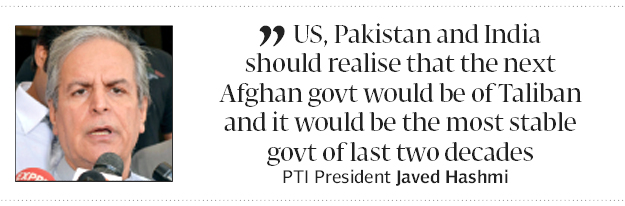
The PTI president came out openly in support of the Taliban. The US, Pakistan and India should realise that the next government in Afghanistan would be of Taliban and it would be the most stable government of last two decades.
He called for ending the operation against Taliban in Afghanistan and bringing them on negotiation table. All Taliban in Afghanistan want to have best relations with Pakistan among all the countries of the world. “Peace is impossible in Afghanistan without Pakistan and this is the universal truth,” Hashmi said.
Nawaz Sharif is dreaming like Zardari about the love of the people of Pakistan without assessing that worst inflation in Pakistan and hike in the prices of electricity and petroleum products have sown the seeds of hatred in the hearts of the people of Pakistan against them.
Published in The Express Tribune, October 24th, 2013.

Muhammad Tahir-ul-Qadri claims Nawaz agreed on drone hits

ISLAMABAD  - Dr Muhammad Tahir-ul-Qadri, the leader of Pakistan Awami Tehreek, has claimed that Prime Minister Nawaz Sharif in a meeting held with US Secretary of State John Kerry ahead of his meeting with President Obama had agreed to continue drone attacks.
He said that the government, however, would continue to make hue and cry about putting an end to drone strikes for face saving aimed at deceiving media and the people of Pakistan.
He said that the agreement was also reached between the PM and John Kerry to give information to the American Security Agency unilaterally without taking ISI into confidence. It was also agreed that Pakistan would purchase the American weapons worth billions of rupees, he said.
Dr Tahir-ul-Qadri expressed these views while addressing the executive council of PAT on Wednesday. He said that the agreements with Iran including that of Iran-Pakistan gas pipeline would not be pursued vigorously; adding that the government would hold talks with the American-supported Taliban factions.
He further claimed that the PM in the meeting with John Kerry had also agreed to privatization of 15 state-owned enterprises. He said that Nawaz had assured the US Secretary of State that the policies would continue as per American wishes

IP project under existing GSPA termed unviable

ISLAMABAD: The Iran-Pakistan (IP) gas line project under the existing gas sale and purchase agreement (GSPA) would not serve Pakistan, rather electricity generation on the said gas would incur additional cost to the country, stated the Sustainable Development Policy Institute (SDPI).

In its report on ‘Rethinking Pakistan’s Energy Equation: Iran-Pakistan gas pipeline’ launched on Wednesday, the Pakistan’s eminent think-tank said this project can be very beneficial if Pakistan manages to sign gas price deal on flat rate as done in Turkmenistan-Iran gas price deal.

This will be a death sentence for Pakistan’s economy if the gas is imported from Iran under IP gas line project under the existing gas sales price – which is linked with the Japan Crude Cocktail price.

The report authored by Arashad H Abbasi, eminent energy expert, argues Iran is importing gas at the price of $4/MMBtu from Turkmenistan and it is assumed that this price has not been linked with crude oil.

The report mentions that Iran, while importing gas at such a nominal price, is exporting gas at $14/MMBtu, which is subject to periodic revisions in accordance with the prevailing market conditions.

The Pak-Iran sovereign agreement stipulates construction of Pakistan’s side of the pipeline by December 2014. The latter will be liable to heavy daily penalties if failed – which can run into millions of dollars per day. Iran has already made the investment and it has a legitimate expectation of return. If the Pakistani government is serious about this project, it must renegotiate the price in line with the GSPA.

Iran had also signed memorandum of understandings with United Arab Emirates, Oman, Bahrain, Kuwait and Syria. Yet as of 2013, none of these memorandums culminated in a General Sales Price Agreement (GSPA). Other than political misunderstandings, the prime cause of breakdown in natural gas negotiations was pricing disputes. For example, in its contract with UAE, a pipeline was constructed in 2008, but the countries had disagreements on pricing.

Abbasi said historically the pipeline gas imports by European countries and LNG imports by countries in Far East have been linked to oil products. However, the gas prices have been decoupled gradually from oil prices in current context of high oil prices and increased supply of gas.

This enhanced supply of gas is principally due to dramatic increase in development of unconventional resources. This decoupling of oil and gas prices have resulted in the price ratio of a barrel of crude oil to a MMBtu of natural gas rising to over 25:1 on a sustained basis well in excess of 6:1 the ratio based on pricing energy content at parity. The report also mentions the transformed energy landscape across the world has also significantly influenced the international gas markets, substantially bringing down gas market prices.

The international statistics of gas prices from 2007 to 2011 identify that the economic bubble had subsided and the gas prices had fallen significantly all of three hubs as by the end of 2012, the Henry hub prices of gas was dropped to $2.76/MMBtu and $9.46/MMBtu in case of UK NBP.

The LNG import price after incurring the shipping and regasification cost (3 percent for transportation, 20 percent for liquefaction and 30 percent for re gasification) for year 2012 was also around $4.15/MMBtu, which identifies the price of IP gas is even costlier than the LNG import price.

The reports said the major driver behind IP gas agreement was high cost of electricity generation from power plants using furnace oil and it was considered that importing gas under IP will be the only penance for endemic energy crisis by reliving the import bill of Pakistan. The annual savings were estimated to be $2.44 billion per annum. This cost of electricity generation is based on the cost of gas provided to thermal power plants of Wapda and KESC at the rate of Rs488.23 per MMbtu.

In one year before the commencement of IP, the report said the improvement of thermal efficiency is indispensable for reducing the power shortfall in Pakistan. In this regard, Pakistan should learn from Iranian experience, which being the leader in natural gas reserves is converting its open cycle power plants into combined cycle power plants for optimising the use of gas and cost of electricity generation.


Pakistan with depleting gas reserve and suffering from endemic gas shortfall urgently needs to improve the efficiency of its power plants. The increase in efficiency will lead to more production of electricity as in the baseline with same quantity of gas, which will also reduce overall CO2 emissions.